
SAP Business AI in 2026: What Joule Work Means for Businesses
Businesses exploring enterprise AI often face the same challenges: fragmented data, repetitive manual tasks, and business processes that require employees to switch between multiple systems. SAP Business AI addresses this direction by embedding AI capabilities into enterprise applications and workflows, helping organisations connect business information with day-to-day operations.
SAP continues to expand its Business AI portfolio through Joule, AI assistants and specialised agents designed to support work across business functions. Its 2026 announcements around Joule Work reflect a broader shift towards AI-enabled workflows that connect business context, information retrieval and task execution.
For Malaysian businesses, the priority is to understand where these capabilities fit within existing ERP processes, what data and integration requirements they introduce, and how they align with operational objectives. This article explains SAP Business AI, the role of Joule Work, and the key considerations for organisations evaluating AI as part of their SAP transformation strategy.

What is SAP Business AI?
SAP Business AI refers to AI capabilities integrated into SAP applications and business processes. Rather than operating as a standalone tool, these capabilities are designed to work within enterprise workflows, using relevant business information to support activities such as analysis, information retrieval and task execution.
Its relevance extends across finance, procurement, human resources and supply chain management, where employees regularly work with business data, approvals and interconnected processes.
For organisations, the objective is to apply AI where it addresses a defined operational need—not simply to introduce another technology layer.
What Is Joule Work?
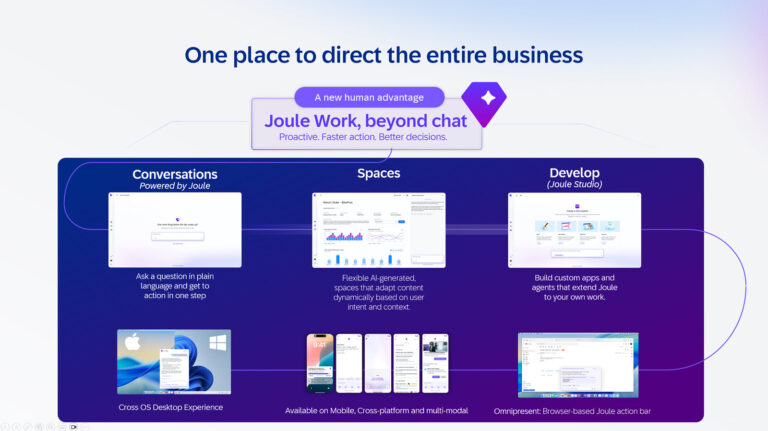
Joule is SAP’s AI-enabled user experience for interacting with business information and capabilities. Joule Work extends this direction towards a more connected working experience, helping users engage with information and workflows across applications.
The business implications depend on the capabilities available within the relevant SAP environment. Organisations should assess the applicable product, licensing, integration requirements and rollout status before determining how Joule Work fits into their operations.
What Should Businesses Consider Before Adopting SAP Business AI?
Successful AI adoption depends on more than feature availability. Businesses should evaluate three foundational areas:
Data and Integration
AI-enabled workflows rely on relevant business data and appropriate access to connected systems. Organisations should assess data quality, integration requirements and access controls before introducing new use cases.
Process Readiness
AI is most useful when applied to a clearly defined business process. Reviewing existing workflows helps identify repetitive activities, information bottlenecks and opportunities to improve operational consistency.
Governance and Human Oversight
Businesses should establish appropriate controls for data access, approvals, exception handling and the validation of AI-generated outputs. The level of oversight should reflect the business process and its associated risks.
Integrating AI into an SAP Transformation Strategy
SAP Business AI should be considered alongside an organisation’s wider ERP, integration and process modernisation priorities. A structured assessment can help determine which use cases are relevant, what preparation is required, and how progress should be evaluated.
iByte Solutions is a Kuala Lumpur-based technology consulting firm and certified SAP Gold Partner supporting organisations across Malaysia. Businesses exploring SAP-led transformation can learn more about iByte’s digital transformation services and assess how their technology priorities align with their operational objectives.
Ready to explore SAP transformation for your business? Contact iByte Solutions to discuss your requirements and identify the next steps aligned with your business goals.